Dave's book review for The Card Catalog
Author: The Library of Congress
Pages: 224
Finished reading: 2026-07-05
Back to my books page for more reviews, etc.
My Review
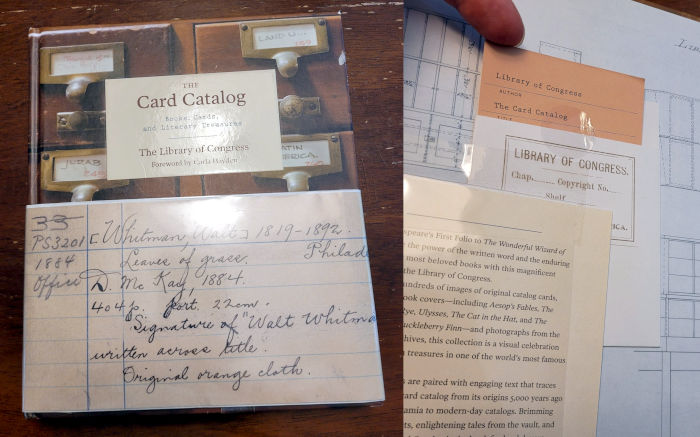
First of all, this hardback is itself is a totally eye-catching piece of art with the half-height dust jacket that makes it look like the book is tucked in a pocket. Inside, a faux due-date card is tucked in an actual pocket, just like a real library checkout. (As a matter of fact, this copy is a real library checkout - from my local county library and you might be able to just make out the standard clear jacket cover in my pictures.)
This is a pretty quick read. The text feels like a literary magazine’s worth of articles. Many of the pages are full spreads with a photo of a historic book from the Library of Congress’s collection on the left and its catalog card on the right.
The Library of Congress’s website page for this book has some sample pages showing this format:
I knew the subject would be interesting even before I knew why it would be interesting. Before anybody came up with the standard index card, how did they keep track of an enormous book collection that was constantly growing at an ever greater rate? It’s an engaging problem.
The humble card is a brilliant answer to the problem. Compared to bound printed catalogs, cards form a type of database that can accomodate additions, edits, and deletions much more easily. Also, you can fill a card with annotations and notes - and even expand entries to flow onto multiple cards. Such a catalog can be a valuable storehouse of knowledge.
I was only a couple pages into this book when I was overcome with a great idea: I’ll make a card catalog of my books on 3x5" index cards! This would allow me to:
-
Sort and organize them without having to make big piles of books in my house.
-
Add notes about when I got the book, why I want to read it.
-
My review when I do read it.
-
Anything interesting about the author I might want to note.
-
Put a star on the cards of valuable books if I croak and the family needs to sell them.
-
Etc.
Seeing so many examples of actual cards with hand-written annotations, corrections, stamps, and various marks left by generations of librarians was very inspiring.
Well, I made 3 cards of my own before I said, "Okay, nope, I need to do this digitally as I have always planned." But now I have a better idea what kinds of information I want to store. I’ve written up a whole notebook page full of ideas for that. Watch this space for updates. (Don’t hold your breath, it may never happen. (But it might!))
Back to the book review:
I learned about the massive challenges the Library of Congress faced in trying to keep track of the constant influx of books, the development of the card catalog, and the publishing of the card catalog as a service to other libraries (who would have to otherwise create their own cards for every new book as well)!
I learned that a branch of the Government Printing Office was set up in the Library of Congress’s Card Division to create hundreds of new cards on linotype machines per day.
By the way, linotype machines are a whole gosh darned fascinating rabbit hole you will definitely enjoy going into if you have the slightest interest in printing, types and fonts, publishing, engineering, or metallurgy!
The casting section of the machine operated intermittently when triggered by the operator at the completion of a line. The full casting cycle time was less than nine seconds. … An external leather belt on this wheel ran a second jackshaft, which powered the distributor and keyboard matrix conveyor and escapements through additional belting off this shaft. … The spacebands are now expanded to justify the line… forming a tight seal that will prevent the molten type metal from escaping when the line is cast.
Can you imagine typing on a machine with a half-horsepower motor and gas fired pots that immediately converts a line of text into a solid metal slug?
I’m sorry, if you don’t find that interesting, are you even alive?
Back to the book review:
I learned about the "Library Hand" handwriting style taught to librarians for hand-writing catalog cards. The book has some great examples. Here’s a page with some examples from the Cambridge University Library:
And I learned about the Mundaneum, an attempt to catalog the world’s knowledge on what eventually became 12 million index cards:
Considering how much I’ve read about Vannevar Bush’s "As We May Think" (wikipedia.org) and Ted Nelson’s Project Xanadu (wikipedia.org) and Niklas Luhmann’s Zettelkasten (wikipedia.org), I’m kind of amazed that Paul Otlet and Henri La Fontaine aren’t already "household" names to me. Well, that’s fixed now.
I love the optical metaphor for searching at a distance:
Otlet created plans for a "réseau" or network of "electric telescopes" in 1934 to allow people to search through a large quantity of interlinked documents. His idea included the ability to send messages between researchers and to create virtual communities. Too early for computers, his plan made use of physical cards and telegraphs.
Back to the book review:
Above all, I loved the main feature of the book: Seeing all of the classic book covers, many of which I recognized, paired with their nostalgia-inducing catalog cards.
I remember searching in the juvenile department catalog and, later, the main catalog of my childhood public library. I also remember the little stamped due date cards. In fact, I have a couple ex-library books in my own home library that still have the little pocket. One of them has the original card showing the first and last times when somebody checked out the book in the 1980s. I don’t have any library catalog cards, but you can buy them on sites like Ebay if you really want to inject that kind of nostalgia directly into your veins. It’s kinda tempting, to be honest.
It’s really worth giving the chosen card examples in this book more than a mere glance. Some of them have some really interesting hand-made corrections and notes that reward careful study. The book makes little commentary and lets you discover them on your own.
A fascinating and fun book.
|
Note
|
If this book seems interesting, also check out A Place For Everything: The Curious History of Alphabetical Order. |