Forever Worlds
Not to be confused with microworlds, a "forever world" is a (digital) place where you can "go" that you keep alive by visiting it now and then… forever. You don’t start over or reset the world. You’re always just adding and expanding it.
I remember visiting a massive, complex, sprawling personal website long ago ("long ago" as in decades) by someone who had created a little space game you could download (written in C or assembly, I think?) which had absolutely baffling controls, but let you explore a procedurally generated universe of (unlimited?) size. The author said it was a very personal project and it was a comfortable place to be and they returned there often. This is all going from memory, so I might have some of the details wrong.
I have thought about my brief time in that little space ship and its universe of stars and what the author said about it off and on ever since. There was something very appealing (if also a little lonely) about it that stuck with me.
I think a forever world can probably exist in a lot of forms.
The Brontë family (wikipedia.org) is famous for the the writings of the sisters (Charlotte wrote Jane Eyre, Emily wrote Wuthering Heights, and Anne wrote Agnes Grey) but I’ve been fascinated with the fantasy world the children created ever since I read about it in a book about roleplaying.
From the Wikipedia article:
Glass Town came into existence, followed by the Empire of Angria. Emily and Anne created Gondal, an island continent in the North Pacific… In the beginning, these stories were written in little books, the size of a matchbox and cursorily bound with thread. The pages were filled with close, minute writing, often in capital letters without punctuation and embellished with illustrations, detailed maps, schemes, landscapes and plans of buildings, created by the children according to their specialisations. The idea was that the books were of a size for the soldiers to read. The complexity of the stories matured as the children’s imaginations developed
Children and adults have been creating collaborative fantasy worlds for as long as we’ve had the cognitive ability to do so. But they’re usually ephemeral.
A fantasy world that sticks, is pretty special. It’s like having a real-life Narnia you can visit any time you like.
A website as a "forever world"
I just read a blog post that resonated very strongly with me:
A forever world in Minecraft is the concept of starting a world in Minecraft single-player, and playing that for the rest of your life. … [Y]our forever world, each time you play, is molded into a reflection of your mind. Each time you build anything, try to leave it there. Don’t destroy it, instead if you want to change something, mold it into something else. You can do this just 20 minutes to an hour each day […] and your incremental progress will show up over the many years in which you’re playing your world.
This is just about the best description of my website I’ve ever heard. It’s a "place" that has been under continuous construction by a single person for over a quarter of a century. It contains my personality and my interests and though I have certainly removed things from it, I’ve mostly been adding to it for all of that time.
All commercial services eventually die off, but a personal website can be nearly immortal. I can (and do) run this site locally off of tiny, low-power computers in the home. So not even an Internet connection is needed for me to use it and add to it.
This website’s About and Explanation of the Ratfactor Feed and What should a personal website be?pages have different takes on what this personal website is. That’s also touched upon here in the Cards under Why am I calling them "cards"?
Other forever worlds
As it happens, I can also relate to the literal Minecraft "forever world" concept. My family logged many hours together in a survival world on our family minecraft server and our buildings and creations there contain lots of memories.
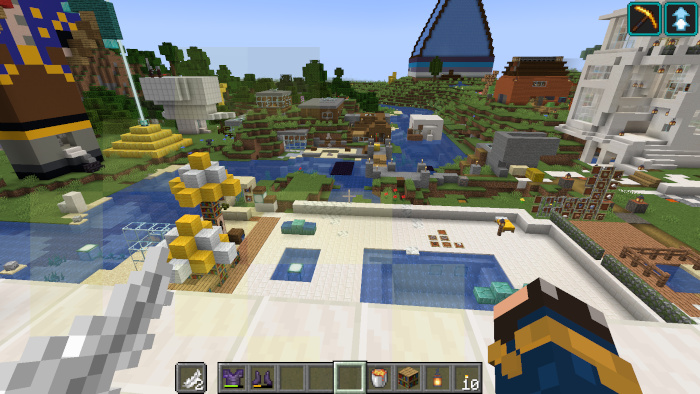
(Note that you might want to consider a game in the FOSS game engine, Luanti rather than a Microsoft product, if you have a choice!)
I think there is some overlap with Seymour Papert’s microworlds.
My sketchbooks are also forever worlds of my artwork. In them, I can see my abilities, interests, and tastes change over time.
Strangely, my notebooks do not feel like a forever world. Despite the fact that there is so much "me" in them, they still feel like more of a reflection of the real world and not so much a world of their own.
Also: Digital gardens
Another metaphor that fits this concept really well is the "digital garden" and the act of "digital gardening". See Digital Gardening.