Right to Repair (and right to own)
When companies violate my sense of justice, it drives me up the wall. The intersection of hardware and software is the hellish crucible in which schemes to scam, fleece, and violate customers have been crafted to a blood-boiling high art by the worst predatory companies on Earth.
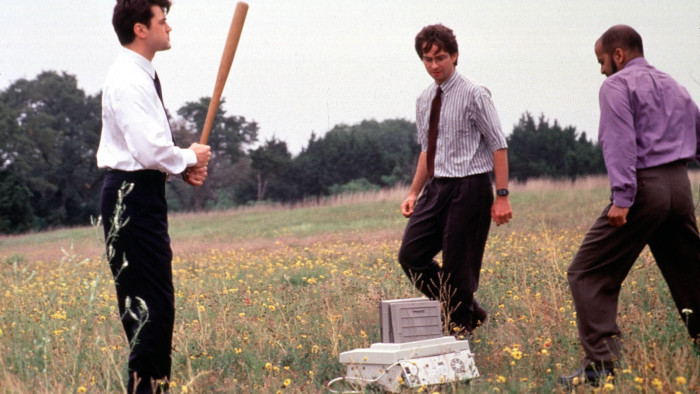
There’s a reason the violent outdoor execution of a printer in Office Space (1999) was a cathartic scene for so many of us. Printers have been the specific instrument of corporate machine torture for ages.
Arguably the Free Software movement got its start from someone being angry at a printer (wikipedia.org):
In 1980, Stallman and some other hackers at the [lab] were refused access to the source code for the software of a newly installed laser printer, the Xerox 9700. Stallman had modified the software for the Lab’s previous laser printer (the XGP, Xerographic Printer), so it electronically messaged a user when the person’s job was printed, and would message all logged-in users waiting for print jobs if the printer was jammed. Not being able to add these features to the new printer was a major inconvenience, as the printer was on a different floor from most of the users. This experience convinced Stallman of people’s need to be able to freely modify the software they use.
A couple years later, Richard Stallman wrote the GNU manifesto, listing four freedoms for users of software (and by extension, computers running that software): freedom to run a program for any purpose, freedom to study the mechanics of the program and modify it, freedom to redistribute copies, and freedom to improve and change modified versions for public use. The GNU Project was born and the rest is history.
About thirty five years later, the complete insanity of printers reached its present state when HP’s inkjet printers started enforcing cryptographic DRM to reject non-HP ink cartridges:
HP has long installed a security chip in its cartridges and printers. If you use knock-off cartridges, you’ve probably seen a warning at some point that it isn’t HP-approved. Annoying, but that’s about all. Last year, though, HP implemented a firmware update in enterprise printers that, as of last week, locked out any cartridges but its own.
To be clear, this is outrageous because HP changed the behavior of the printer you already own that was sitting on your desk to be more restrictive in the company’s favor.
It makes the lack of available source code in Stallman’s Xerox printer, the irritation that helped launch the software movement that arguably powers the computing landscape as we know it today, seem almost laughably quaint.
The most powerful tool available to rapacious corporations today is the 1998 Digital Millennium Copyright Act (wikipedia.org).
And one of the more notable pieces of DMCA caselaw was about, you guessed it, printers (wikipedia.org):
…Lexmark cartridges included a computer chip that included a 55-byte computer program (the "Toner Loading Program") which communicated with a "Printer Engine Program" built into the printer. The program calculated the amount of toner used during printing: when the calculations indicated that the original supply of Lexmark toner should be exhausted, the printer would stop functioning, even if the cartridge had been refilled.
Yeah, Lexmark beat HP to the news with an inkjet printer by a couple years. They lost the case in question, a "rare defeat for large printer manufacturers like Lexmark, Hewlett-Packard and Epson in their ongoing battle with third-party ink sellers." Indeed.
Cory Doctorow has written a ton about the DMCA, including the crazy situation with the Taylor ice cream machines that are often out of service at McDonald’s:
The US Copyright Office frees the McFlurry (pluralistic.net)
These machines – which extrude soft-serve frozen desserts – are notoriously failure-prone, with 5-16% of them broken at any given time. Taylor, the giant kitchen tech company that makes the machines, charges franchisees a fortune to repair them, producing a steady stream of profits for the company.
As Doctorow points out, with examples, the DMCA has been used to lock down a huge variety of devices (garage door openers, refrigerators, dishwashers, treadmills, tractors, cars, printers, "and even printer paper").
As you might expect, this is quite a tempting proposition for any manufacturer hoping to enshittify their products, because they know you can’t legally disenshittify them. These access controls have metastasized into every kind of device imaginable.
The tractor example refers to John Deere, which has turned out to be one of the most famous examples, capturing wide media coverage. As iFixit’s Kyle Wiens writes:
It’s official: John Deere and General Motors want to eviscerate the notion of ownership. Sure, we pay for their vehicles. But we don’t own them. Not according to their corporate lawyers, anyway.
In a world where Stellantis, the owner of Jeep, has toyed with putting pop-up advertisements for extended warranties (no joke) in their vehicles and just about every new television is now a "smart" device (read: demands an internet connection, spies on you, and might even show its own advertisements), and Silicon Valley has devolved into a self-feeding pit of comically evil misanthropes, I trust the big corporations of the world exactly as far as I can throw them.
The Bond villain gathering known as the World Economic Forum (WEF) in Davos gave us the incredible phrase, "You’ll own nothing and you’ll be happy." (Which, to be fair, may have been taken slightly out of context. But it has stuck.) The very notion of buying something and paying for it once seems to be under attack.
For many of us, physical media has become a safe haven from being made to rent ("stream") our favorite music and films.
But what do you do when your dishwasher or refrigerator comes seeking rent?
Or your printer: The nightmare is real: HP makes printing a monthly subscription (pcworld.com).
The right to repair (wikipedia.org) movement is about wresting at least one dimension of user rights back from the corporations: the simple right to repair the objects we have purchased.
Repairing is a sacred right passed down to us from the first tool users, hundreds of thousands, if not millions of years ago.
The right to repair may sound fairly narrow, but if you can repair a thing, you can also assert ownership over it in many other important ways:
-
Modify the device to stop spying on you (privacy and safety)
-
Continue to use the device after is has been "broken" or marked "obsolete" by the manufacturer (frugality and conservation)
-
Use the device in emergency situations for which it was not designed (health and safety)
If you can’t repair something, you do not truly own it.
Beyond being sleazy and wasteful, using copyright and DRM to control the entire life cycle of every device you sell is just wrong. It has zero public good or utility. The only motivating factor is greed.
If you are interested in getting really angry, I highly recommend reading the Wikipedia page about the past and present of planned obsolescence (wikipedia.org).
The fact that appliances now have drastically shorter lifespans despite improvements in materials science, manufacturing capabilities, and the availability of insanely reliable microcontrollers shows the damning failure of "markets" to provide what people actually want.
The only way to ensure we don’t all end up living in rented homes running rented appliances connected to rented services is to force change through legislation. I’d love to believe that I could simply not purchase things that offend my sense of justice and those things would disappear. But I haven’t seen any evidence that it works that way and I haven’t heard a convincing argument for why it would work that way. Not when corporations (and even some individuals) control more wealth than countries.
The language of "consumers" is the language of vassals and serfs. Refuse the terms as offered. Using an old device is our right. Repairing a broken device is our right.
Heck, I think I’d go one step further to make this real simple: All devices in a home belong to the humans that live in that home. Period.
Also, don’t make me tap the sign:
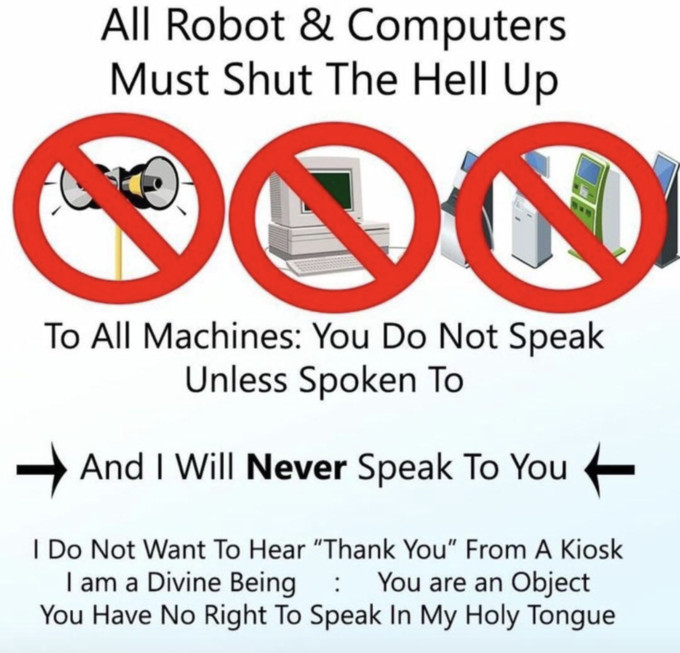
(Original meme artist unknown, sadly.)