Technology addiction and burnout: It's not your fault
BRAIN DUMP ALERT!
In an email conversation today, (Project Inbox 2026 is going well), I was really struck by the very apt comparison my new friend made comparing Big Tech with sugar.
I’ll paraphrase because I don’t want to quote without permission:
My family is struggling with sugar. I want to put my foot down and say, "This is nuts, we should just not have it in the house!" But that’s difficult to enforce and… Pointless. Sugar is part of just about every social event and aspect of public life. You’d have to leave society to escape it entirely. So, somehow, we have to learn how to navigate a world filled with sugar.
(My paraphrase doesn’t have the impact of the original, but I think you can get the gist of the idea.)
Followed by (again, my paraphrase):
If technology is sugar, then the Big Tech broligarchs are sugar companies. There are more and less healthy ways to get sugar into your diet. Think fruit versus candy. The computer can deliver both at the same time.
I recently read this piece by Terry Godier (March 2026) that feels extremely relevant:
You should read the whole thing because it’s incredibly well said and a piece of art in its own right.
The "plain text" version is also beautiful:
For the rest of this page, I’ll assume you’ve read it.
After showing us how modern tech has weaseled into our lives and taken over our time and attention, Terry gives us absolution (and vindication):
"This is not your fault. The tiredness is not a character flaw. The guilt, the sense that you should be handling all of this better, more gracefully, with less friction, that guilt was manufactured. It was placed inside you by an industry that profits from your participation and a wellness culture that profits from your shame."
He’s right.
And my email friend is also right, we’re constantly drowning in a world of sugary distractions. We know they’re harming us.
But just "learning how to live with it" is only going to work out for a few iron-willed people.
For most of us, if we try to break away at all, it often looks like an addict’s cycle of swearing off the thing and abstaining for a while. But then giving in and going back to it with a sense of shame.
Abstinence works, if you can figure out how to practice it.
But you’d have to be pretty insulated from the society I live in to abstain from computers.
An Internet-connected device isn’t like other devices
Terry Godier spelled it out for us. "Smart" computing devices with Internet connections are perpetually needy in ways that disconnected "dumb" electronics are not.
Like Terry, I love my wristwatch. This is my Casio G-Shock GW-M5610. I’ve been wearing this as my sole wrist companion for a couple months shy of a decade. It recharges with the tiny solar cells around the face. I’m still on my first battery.
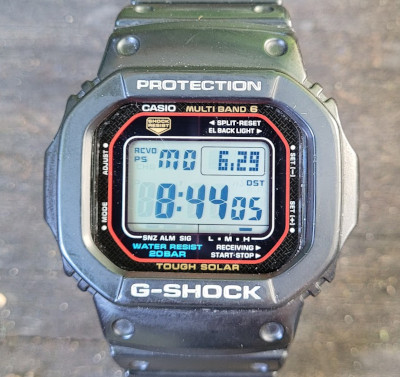
(The watch is black. The green tint is from the nearby leaves of a tree.)
Unlike Terry’s F-91W, this watch does get updates over the air: Every night, it listens on 6 different standard time radio bands from Japan, North America, the UK, Germany, and China. It does this magically.
But it’s the good kind of magic. It just silently does its thing, showing me the exact time. If the radio signals ever stop, it won’t be bricked, it’ll still keep excellent time.
These days I see a lot of people with "smart" watches and I can’t tell you how weird it is that I’m not one of them.
If you told me a decade ago that wearable wrist-computers would be readily-available and that I wouldn’t own one, I would have said you must be mistaken. A wearable wrist computer has basically been a childhood dream of mine since I saw my first calculator watch. My dad had a Casio Databank (wikipedia.org) watch, and later, I had one too.
But these things we have now? Bad magic. I haven’t even been tempted. What a crazy time to be alive.
Why? What makes them bad magic? How could it be that I am the same person who once dreamed of a wrist computer and yet I am not even tempted to own one now?
I know there are exceptions, but the vast majority of the smart watches currently available are extensions of the Apple and Google cell phone ecosystems. In other words, they are wrist-mounted conduits to propriety mother ships. When they get updates, it’s because somebody in a company hit a button. You’ve put the damn "Cloud" on your wrist.
It’s exhausting to think about it, but every single "smart" device (and a computer is the freaking smartest) in your house is a ticking time bomb of attention-stealing, terms-of-service updating, self-modifying box of future problems.
Why do we even buy these things? Because they promise convenience, entertainment, and dopamine. It probably seems useful, but more than that, you think that if it works out, it just might make you happy.
An Internet-connected device is not just sugar you ingest once, it’s a sugar delivery mechanism. And when you make that purchase, that sounded real good.
Of course when you’re lying, bloated and unhappy, on the floor while the machine continues to pump syrup onto your leg, you wonder what you had been thinking.
What’s worse, many of us have to use one for our jobs, so it’s not like you can just opt out entirely. For us "knowledge workers", you’re sitting right at this huge conduit that leads, by default, straight into the roaring rapids of Big Tech’s Giant River Of Convenience At The Cost Of Your Everlasting Soul.
It’s the same problem I have when I try to cut down on my overeating: I can’t just avoid food forever. I do have to eat. So I have to just keep making the right choices over and over again.
Meanwhile, the bad choices are just waiting a mouse click away. Of course you’re going to get exhausted and screw up. And screwing up makes you feel bad because you should have been stronger and… Now you’re on a binge cycle until you get angry enough to quit again for a while.
That’s what makes computers so hard.
When I’m not working, I don’t have the apparatus of the job to keep me on task, so it is especially important to keep myself on the straight and narrow. That’s one reason why I practice Ascetic Computing.
Fellow parents: I hear a lot of tough talk from people with no kids. But let’s get real. How can we keep our kids off the sugar if we can’t even save ourselves? Interacting with Big Tech is literally required for most schools. I don’t have any answers here. Just fear and questions.
Whee! I’m in a great mood today.
Let’s take this Magic School Bus To Hell on a slight detour…
"Social Media:" A different kind of sugar, but from the same multinational brands you trust, LOL
I wrote about my own struggles with being hooked on the Internet’s dopamine hits in one of my RSS Club entries in the year 2022, so I’ll quote myself:
"Multiple attempts to curb this behavior from various angles have failed miserably. If this isn’t an addiction, then we need a new word for it."
I can go days, even weeks at a time from visiting popular tech forums or the various "microblogging" platforms, but I always come back. And I always regret it.
Even reading blogs and full-blown essays can do this to me. Yes, even my beloved Indie Web. A long, well reasoned opinion piece is probably better, but it’s kind of like eating a seven tier wedding cake instead of a whole bag of candy. I’m getting way too much sugar either way.
Ingesting large quantities of other people’s opinions in the year 2022 was not great. But at least I would occasionally come across neat projects and ideas.
However, in the year 2026, it’s instant regret. Once I start, the only thing that keeps me reading is my desperate need to see someone else express my viewpoint so I don’t feel completely crazy.
To put it another way:
-
Internet dopamine addiction 2022: A slot machine because sometimes something good would come from it.
-
Internet dopamine addiction 2026: A button that gives me a punch in the stomach.
Obviously it’s bonkers to keep doing something that always makes me feel bad.
Yet here I am. What the heck is going on?
For one thing, I wasn’t wrong in my follow-up RSS Club post:
"It turns out I don’t have a Web Surfing Problem per se… What I really have is an avoidance problem. Faced with unpleasant feelings of being overwhelmed, I seek relief."
Okay, true. That’s a huge part of it.
But it’s also the human desire to be heard and understood. I am fully aware that by writing this page, I am contributing to the existing body of Other People’s Opinions. But I needed to write it.
Is the old "Duty Calls" XKCD is showing an addict in the depths of a binge or just a human wanting to be understood?
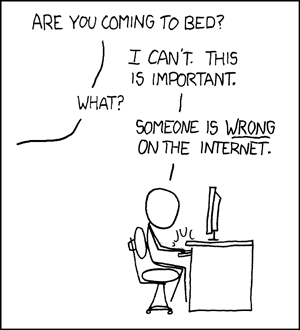
What is an argument but a desperate need to be understood?
I needed to write this, but I’m not to post it anywhere. That seems like a good compromise. This will just be a card sitting here in the box.
I needed to write it, but nobody needs to read it.
If you found it and liked it, great!
Or sorry.