Finishing Things
This was originally supposed to be a pretty short note. But it turned out I had a bunch of related thoughts all tangled up. And once I started to tease them apart, it became something much longer. This could have been half a dozen separate Cards. (As a matter of fact, some new cards did arise.)
The irony is not lost on me the way this "short note" ended up exemplifying some of the very challenges it’s about: It ballooned in scope; I began to doubt the value of the whole thing; It was hard to finish it.
What follows is a bracingly honest assessment of how I do (and don’t) sometimes finish projects.
The folly of big time-based plans (what isn’t working)
First, the good news:
It used to be, not that long ago in my memory, that I hardly ever finished personal projects. I started stuff and would work on them like the blazes until something stopped me and then that was it. One shot each.
That finally changed somewhere over the last ten years and now I finish some of the things I start. Being able to say that is awesome and I earned it because it wasn’t an easy road getting here.
Now the "bad" news:
High on the success of actually finishing personal projects for a while, I started to think bigger. Big, foolish plans.
I started making year-long declarations. "Resolutions," if you will. Mostly in private, but here’s some public ones:
-
The Year of Try It (plans for 2024)
Those didn’t go very well. Or, at least, they didn’t go like I’d planned.
The truth is, I’ve been going through some tough things and they started around that time. Most of it is big emotional toll stuff. You know, the kind of stuff everyone generally agrees is painful and hard. Some of it is just hard for specifically me. But I won’t be writing about any of these things on this page, so don’t bother looking for clues. The point is, I picked a heck of a time to start making plans.
If that weren’t enough, external factors have even dictated the order in which I’ve had to tackle my personal projects. For example, The Microslop takeover of GitHub caused me to replace it with a small Ruby script for project hosting. Likewise, I had to accelerate my OpenBSD adventures out of necessity on no less than two occasions. In both cases, I already I wanted to do those projects, but I had planned to do them much later. Not a big deal in the long run, but, you know, irritating. Not to mention devastating for my plans.
And all of that is okay. That’s why I put the quotes around "bad" news.
Hey, I know where I stand in the larger world. How many people on Earth are in a position to pursue personal goals at all? I am grateful for what I have and I do not go around the house wallowing in self pity all the time. (Just some of the time.)
The point is, trying to plan out all the fun/enriching stuff I want to do isn’t doing me any good. It’s not for lack of trying that it’s not working. It’s just literally not possible to make those kinds of plans right now. So I’m going to try to stop doing that. No more making big plans. No more, "This is the year I do XYZ…"
The joy of the stack (what is working)
Here is my project stack:
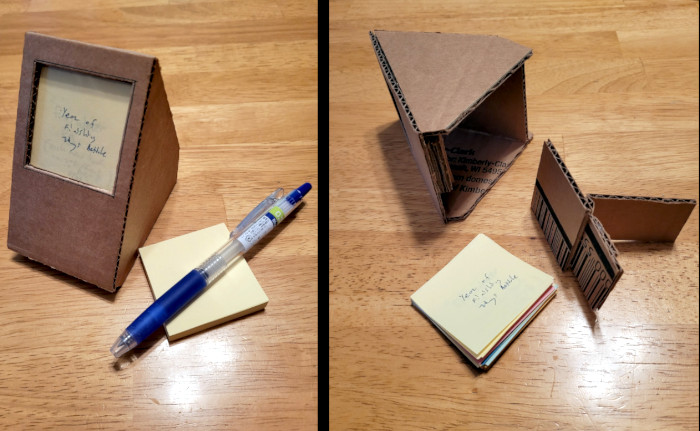
I originally wrote about the concept here: The Project Stack! and here: My "Project Stack" Display.
The way it works is simple:
First, when I get a new To-Do or idea for a little project, I write it on a mini Post-It note, open up the display, and stick the note somewhere in the stack.
Sometimes I stick the new thing near the bottom. I want to do that project eventually, but not yet. But there’s a reason I’ve got a stack: The new thing goes on or near the top more often than not.
Confession: If I’ve got a real quick thing, or at least something I think will be real quick, I sometimes just stick it right on top of the display.
Then, when I get back to my desk and I need a reminder of what I’m doing, there’s just one item staring back at me, so I work on it. Amazing, right? I can hardly believe it either.
This system works for me because:
-
The top item is the only thing I’m working on.
-
The other things are out of sight, but I know they are there, not forgotten.
-
I trust my past self to have chosen the correct order in which to do the items.
-
The display adds enough friction that adding stuff is an intentional act.
-
There’s a bit of ceremony to adding and removing which helps me feel like I have a bigger plan at work.
The reason I landed on the FIFO ("First In, First Out") stack, and not just a list, is that projects tend to beget other little projects. Little side quests that need to be completed first. Have you ever noticed that?
Like, I’ll get started creating a program and then realize I need to create another little helper program to help me out with it. And that works really well, so I ought to create a little web page for the helper program and whatever I learned because Web Page or It Didn’t Happen! and Sharing is caring. (For a good example of this, see my mention of "Meow5" below.)
Sometimes digging yourself into a simple hole, no matter how deep, is better than digging yourself into a warren of haunted crypts
It’s easy to get lost in all of the side quests. I start something pretty straightforward like digging a well because I need water, but due to some unforeseen quirk with the local geology and water table I need to also dig all these little branching side tunnels as I go. The next thing I know, I’ve created an underground maze.
This is why I don’t do well with traditional "To-Do" lists. Everything just gets appended to the list and it becomes an overwhelming jumble.
By forcing new items to go on and off the stack in such a strict linear manner, I’m forcing myself to turn that maze of tunnels back into a linear hole. Which may not sound super appealing, but at least a hole is tractable!
I mean sure, you can die trying to get to the bottom of a hole, but you don’t get lost in it. You can’t forget something you left behind around the corner of that darkened passageway. Your hole doesn’t get haunted by the dead and dying projects you accidentally abandoned.
Honestly, right now, the "digging myself into a hole" metaphor is better than I would like. When I took the picture above, I counted my current stack. There are, yikes, 38 notes in there! But I swear some of the top ones are things that I can get done in, like, a day at most. Okay, maybe a couple days. Or a week. Whatever.
As I noted in my original article, popping items off the stack feels awesome. It’s more visceral for me than checking off an item on a To-Do list. That’s part of the "ceremony" I mentioned.
(In the interest of full disclosure: I said To-Do lists don’t work for me. But the funny thing is, I’ve recently started using them again. But here’s the deal: They’re in my pocket notebook and they’re my intentions for that day only. They’re strictly a reminder, and they do not carry over. Very helpful. (Speaking of, I’m totally planning a shorter follow-up to that notebook system page with my more recent practices. And, yes, that’s one of the 38 things in my stack! Do you want tunnels? Because this is how you get tunnels! (And parenthesis!)))
Good habits, and how they come crashing down
In addition to working on projects, I try to keep up good habits. Some of them are far easier for me others. (And sometimes the ones I consider "easy" and "hard" swap places.)
Examples of daily habits:
-
Exercising
-
Keeping a good diet
-
Transcribing my log (notebook page to computer text file)
-
Chores like laundry and dishes
-
Drawing in my sketchbook
-
Writing
-
Study of a difficult subject
-
Progress on a medium-size personal project
When things are running smoothly at home, I’ll get a couple of these habits going. It feels great.
Then I start to add habits.
I picture a plate spinner (wikipedia.org) act. I’ll get a habit going successfully. That’s one plate spinning away. So I’ll think, "Okay, I can add another plate", and sure enough, that goes well too and now there’s two plates happily twirling around on the ends of poles.
So I add another and so on. That goes for a while and this is great! I’ve got all these plates going and I’m feeling good and getting things done and I feel on top of the world. Wow, look at me! I’m keeping all this going no problem! I am such a successful person!
Then, inevitably, an external force messes up my little setup. ("Argh, there’s no way I can do this one habit in the morning anymore because our schedule has changed.") It’s like one of the lions escaped from the other ring in our little circus, came over, and attacked one of my plates. So that plate comes down. Sensing action, all the lions come over. Plates fall left and right. I don’t know exactly what happens next, but when I come to my senses, I’m sitting in a pile of shattered ceramic.
Uh oh, some of those plates were medium-to-long term projects I was keeping alive through incremental progress. When one of those plates falls, it’s much a much worse situation. It’s not like breaking a perfect streak of laundry. I can start laundry up again any time like nothing ever happened. It’s nothing like laundry.
When a project plate falls, that’s a whole little dream laying in pieces that will get swept up, for now, into a little coffin-shaped box and placed in a shadowy niche with all of the other half-finished projects. I find it hard to explain to anyone why this part is so heart-breaking. How hard I was trying to keep that project alive. How many hopes I had spinning up there on that plate.
As an aside, I think it’s worth noting that you should not compare yourself with famously productive people. It turns out a bunch of them didn’t even have lions. No fair!
Keeping the habits/projects/workshop "alive"
You can’t help notice the larger pattern of the plate spinning after it happens a dozen times. You get the plates spinning, something comes barging in, the plates crash, you take a break. You rest .You get some plates spinning again. Repeat. After a while, the mere idea becomes exhausting. What to do?
I try to remember two things:
First, I do not need to keep all the plates going when the lions come in.
My goal isn’t to impress anyone, not even myself. My goal is to protect some plates, maybe as few as one plate. Keep them moving if at all possible.
With at least one plate still spinning, I still have something I can point to and say, "Well, at least I’ve still got this."
When things ease up, I find its easier to start a second plate when you’ve already got one going. If that second one fails, fine, go back to one, take an Intentional Rest, and try again later.
Second, even a very wobbly plate that is barely barely spinning is still spinning. It can wobble and tip and make the audience gasp. That’s okay, it’s just gotta stay up.
It’s so much easier to maintain a spinning plate than it is to get one going from scratch!
I’ve learned to have a mixture of easy things and hard things. Easy habits are, say, drawing in my sketchbook or doing a little maintenance on my website. If either of those don’t sound easy to you, that’s probably because you haven’t seen some of my worst sketchbook doodles or my most feeble website updates!
Maintaining skills
It’s not just habits and projects. There’s also the element of keeping your skills sharp by using them, not letting them atrophy.
For example, the purpose of doing a little bit of drawing as close to daily as possible is to keep that skill from fading away. Most of the drawings won’t be masterpieces. It won’t even improve my skill. Both require concerted effort. I just want to not lose the ability entirely and have to reacquire it later.
Trust me, I’ve been down that path plenty of times before and I know where it leads. If I go long enough without drawing at all, I have to build the skill back up. It comes back pretty quickly, but only with effort.
Your reward for making this far is this frog from my sketchbook:
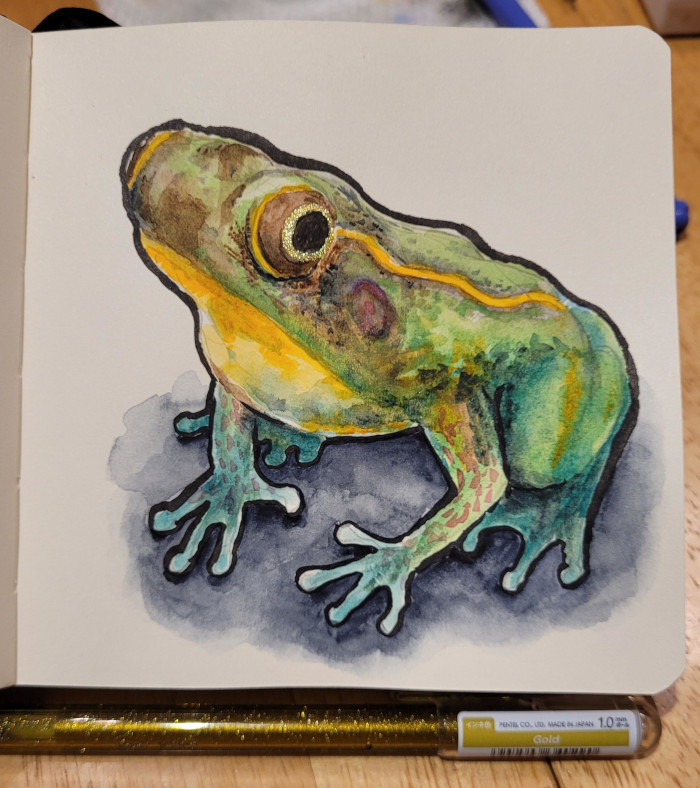
If you look closely, you might be able to see the gold in the frog’s eye that came from the gel ink pen. It’s very sparkly when you tilt it under the light.
And FYI: Like any skill, creativity is also built up or lost like muscle.
The "workshop"
Somewhere between project and skill is the idea of the workshop. That’s where it all comes together: the skills, the tools, the energy. It could be a physical space, a special computer, a notebook, or even just a state of mind.
A workshop that gets daily use is more "alive" than one you go into once a year. If you’re in there all the time, it becomes comfortable and familiar. You know where everything is stored.You have muscle memory for the feel of the bench top and the set of tools close at hand.
I’m at the command line of my operating system every day, therefore it’s comfortable and familiar.
I use my sketchbook and a small subset of my art supplies (mostly pencils, pens, and a tiny watercolor set) almost every day, and so they are also very comfortable and familiar.
By tending to my website (i.e. Digital Gardening) almost daily, I keep the friction very low. If it’s easy to add and edit things, I’m more likely to do that. If I’m constantly doing that, I’m more likely to put in the effort to reduce the friction further.
In my experience, incremental improvements in the workshop are a self-feeding virtuous circle.
What a wobbling plate looks like
Sometimes, when things are really out of my control, I don’t even have the concentration to read a book in the evening, which is something I’ve done since childhood and is about as ingrained as brushing my teeth. When that happens, I read a comic book (rather, "graphic novel" because I am a sophisticated adult) instead. And because at least I’m doing something for myself and at least I’m reading, it’s keeping that tiniest plate up there on its pole, wobbling a little, but still turning.
For the bigger projects (computer programs, written articles, "serious" art), I now rely on the "project stack" described above and I try to keep the top item "alive" by doing the bare minimum on it. Like, opening the project files and staring at them or tweaking the README file. It’s honestly kind of depressing to keep doing that, but it really helps to keep the project from going completely cold. That way, when I get my energy back, I can just pick right up where I left off. The plate never fell off the pole.
There are a lot of terms for this way of thinking like "systems rather than goals" or just "showing up." Joggers may talk about the act of putting on the shoes, or weightlifters putting on the gym clothes, or swimmers touching water. I guess my version of this is opening the text editor.
The point, and this is how I bring all of this rambling full-circle, is that keeping things "alive" is how I eventually finish them without having to kick-start them sputtering back to life.
But even that is possible.
Reviving "dead" projects
As I mentioned in the beginning, I used to work on things in one big blast. Once I lost interest, that project was guaranteed dead. I would never touch it again. Often this was no loss. But sometimes it was, especially when I abandoned them excruciatingly close to the finish line.
The first time I successfully restarted a project after stopping it for a significant span of time was my concatenative language experiment Meow5, which had not one but two 5 month hiatuses (see "Five months pass." in project log 11 and "Five Months Later" in project log 12 ).
Going back to read those entries now, it’s interesting to see how I solved it: I came back and made mini-projects within the project. I incrementally built up additional software tools to help me guide myself through a particularly sticky problem in the main program. The confidence of doing the smaller task helped me get my footing in the larger one.
To quote myself from log 12:
As is often the case, *writing* the programs armed me
with the intimate understanding of the problem which has
rendered the programs themselves largely superfluous.
Finishing that project after all the delays, as imperfect as the final result may have been, felt soooo good.
I have a project that has been in stasis now for over two years. It’s way down almost at the bottom of those 38 Post-It notes in the stack. It’s called Hiss and in terms of functionality, it’s basically "done". To make a long story short, I want to pepper the documentation with SVG graphics, but I want them to be tiny (in bytes) so I kinda want to write my own SVG editor with some really specific features. Yeah, I know, that’s nuts. But I’m not asking your permission. It’s my project and I’ll do it how I want. And actually, I think building a little SVG editor will be a great way to break the ice on the main project. When I manage to finish Hiss, it’ll feel amazing.
I’ve got another pretty recent project where I had such a hard time concentrating on it that I actually hand unwrapped a loop and hard-coded all of the separate steps to exactly match my input test case. It was an extreme thing to do, but it let me concentrate on microscopic parts of the problem. I was so frazzled and only working on it for 5-10 minutes per day! That project is in stasis at the moment too, but when I go back to it, it’ll be a lot easier because it’s like I left the microscope with a slide already loaded up - it should be pretty easy to regain focus.
The other things I often add to my software projects that help a bunch when I need to get back after a hiatus are The "Next" Note and "run.sh".
The sphere of control: trying not to stress when you can’t make progress and the plates have all shattered
I’ve got another article coming Real Soon that is basically about how I’ve made one aspect of my life, my computing environment, anti-chaotic in this chaotic world. I do what I can to have calm in my private universe of books, notebooks, sketchbooks, and computers because that’s where I’m in control.
But we can’t control external events. And, dear friends, my life can occasionally switch to being almost entirely dictated by external events. Never mind finishing things or making progress, I can’t even touch the projects.
The feelings that usually accompany the switch are frustration, stress, and guilt. Frustration that I can’t do what I’d planned, stress from trying to fight reality, and guilt that I’ve betrayed myself somehow.
Because of these feelings, it’s hard to switch modes from productively steering the ship to passively holding on for dear life.
Hard, yes, but possible. The rule is: You can’t control what’s out of your control, but you can control what you perceive to be in your control. Does that make sense?
For example, if I’m about to go on a week-long vacation camping in the woods, I can easily accept the fact that I’m not going to be making any progress on personal projects. Maybe this example feels like cheating because the reason is fun and was probably my choice. But it’s still a mode switch.
Having established that switching modes is even possible, the next trick is to do it when the reason isn’t an upcoming fun and relaxing vacation.
Being able to switch modes brings relief because you’re no longer expecting autonomy you don’t have. The good news is that you’re always in charge of switching modes. Getting competent at it is a way to bring back control to your life.
Life rarely comes in simple binaries, though. I can’t just have "steering the ship" mode and "going along for the ride" mode.
Instead, I propose a different model: a growing and shrinking "sphere of control". You should aim to imagine your sphere of control as being exactly big enough to encompass everything you can be reasonably expected to control at the current moment. No more, no less.
Come along with me as I do a little thought experiment: I close my eyes. How small can I shrink my sphere? Maybe breathing. I can control my breathing. Breath in, hold, breath out. Got it. I’m in complete control of that sphere. No stress here, right?
When I expand the sphere, it should contain everything it did before and something extra. So, beyond breathing is getting out of bed, eating, showering. Expanding it some more and we have the essential "adulting" stuff like taking care of the kids, maintaining a household, earning a paycheck.
If I’m doing everything in my sphere, there’s no need to stress. I don’t need to worry about all that external stuff because I’ve already established that it’s out of my control. Needless to say, this requires honesty and acceptance. If you’re still stressing or feeling guilty about "not doing enough" about things outside the sphere, then figure out why that is.
Mind you, accepting is not the same thing as enjoying. Enjoying an imploded sphere is a more advanced skill. Don’t worry about that.
In fact, one of my favorite phrases is, "I don’t have to like it." When I say this, it means I’m going to go along with it and I’m at peace with it, but I’m not going to try to convince myself I should enjoy it. I find this phrase very freeing for some reason.
Okay, so let’s say things have been going great in my sphere for a while. I’m feeling pretty confident. So I start adding those good habits and projects: Diet and exercise, doing a home repair I’ve been putting off, making progress towards my goals and keeping my personal projects alive.
Now this big sphere is fragile. It extends way out. Any small external change can crash into it and wreak havoc!
This sounds a lot like my spinning plates analogy above, doesn’t it? And the external world is the circus lions. You can’t beat the whole world (or lions). When you try, that’s where the stress and guilt comes in.
It’s temping to picture this in terms of growing and shrinking territory, of conquest and defense. The problem with that mindset is that when you inevitably have to shrink the sphere, it feels like retreat and loss. I believe our emotions follow our thoughts.
So don’t think of it as territory. Think of it as something on the move, as progress. If you’re doing everything in your sphere, then you’re always moving it forward and making some progress. A small sphere makes small progress and a large one makes large progress. There is no loss, just different rates of gain.
Even a modest sphere will eventually get to the finish line.
Again, you don’t have to like shrinking the sphere, but you’ve got to accept it and be at peace with it. And if you’re doing everything in the sphere, you know you’re doing all you can do.
Easier said than done, but I think it helps.
The inbox, or "email as both a project and a habit"
Long before Merlin Mann coined the term, I was an "Inbox Zero" guy. Email came in, I answered it within a day or two. Boom. Done!
My current overflowing inbox is a source of both shame and frustration.
The email messages I get are full of very nice notes and substantive writing by really smart and fun people. I’m honored to get these emails and I absolutely want to respond.
The thing is, once things turned hard, my the inbox collected a backlog for the first time in my life. And the more it backed up, the hard it became for me to face it. It snowballed. Eventually I found the whole thing so overwhelming that I stopped being able to dash off quick replies entirely. I haven’t responded to any personal email short of emergencies in about half a year.
Before I tackle it, I want to finish a series of semi-intertwined articles, mostly OpenBSD related, that I’ve got floating around in my head and in various stages of completion. And then, I’m going to turn my inbox into a real project. I won’t work on anything else during that time. Just email. Until the inbox is empty. My thinking is that I just need to clear some junk out of my mind and give myself permission to concentrate on just this one task. We’ll see if it works.
After that, hopefully I can return to my quick response habit and keep up with it like I used to. (I’m also learning to get better about writing shorter responses, but as you can see by the length of this stupid "quick note" of a page, once I get going…)
I probably need to figure out how to keep the snowball/overwhelm effect from happening if the habit fails (cursed lions!), but I guess I’m just hoping I can get that plate back up in the air spinning again and keep it there like I used to.
Update 2026-05-16: This is happening, Project Inbox 2026!
Calling the dentist, or "crossing uncomfortable barriers"
Another challenge with finishing things is to tackle the uncomfortable stuff. I’m okay with hard work. But some barriers aren’t hard in the sense that they are long or difficult. They’re hard because they cause discomfort in one way or another: fear, pain, uncertainty, doubt.
I cracked a tooth the other weekend. I was eating ice cream, of all things.
Even though I shudder at making phone calls and I wasn’t looking forward to what was to come, I made the dentist call right away because the decision was easy. Obviously I had to get that taken care of.
The visit went fine and I got a new crown put on the tooth. But when it was done, the dentist said a cracked tooth could still lead to trouble later. (She was more specific, but I’ll spare you.)
Well, it’s a couple weeks later, and I’ve been having pain pretty frequently. At the moment, it is radiating across my jaw all the way from my ear to the base of my tongue. Swallowing feels like a sore throat. I’m not going to look these symptoms up on the Internet because the results will tell me I’ve got a week to live, like when you watch the haunted VHS tape in The Ring.
I know I can’t just ignore it, yet the thing is, yes it hurts now, but it’s been pretty much fine when I wake up again in the morning. That’s a problem because it lets me trick myself into thinking, "Oh it’s fine." Which, in turn, makes it hard to force myself to make the call. If I hurt all the time, it would be easy to make the call. Pretty dumb logic, huh? That’s brains for you.
I’ve been mulling over this snippet by David Cain:
[A]voidance and clinginess are the real sources of suffering, not the physical ease or difficulty of the experiences themselves.
(Also, that article makes me want to give meditation another shot. The illustrated metaphor is brilliant.)
Similarly, I pretty much always have this Seneca quote floating about in my head:
[W]e suffer more often in imagination than in reality.
Both apply to my current situation vis-a-vis the dentist. The hardest part isn’t sitting in that chair. It’s the leap into the likely unpleasant unknown that making the call will spark. I think that’s the problem some of us have with phone calls in general: They’re leaps into the unknown.)
I know I’ll feel better when the call is done and better still when I’m in the chair because then I can turn the problem over to a professional and more-or-less relax.
The rational brain knows all of that and believes it. So why is it so hard to make that call? Why is it so hard to make the decision to make that call?
I don’t know, but thanks to David Cain and Seneca, I’ve convinced myself I’ll do it first thing in the morning.
Update: I did it. I wasn’t in any pain in the morning, but I made myself call anyway. I’ve got my appointment.
Second Update: I went to the appointment. They buzzed down the crown a bit and explained what kind of pain to look out for and for how long. Now it’s been a week since that visit and the pain is fading away and nearly gone. Yay!
The better you understand your own weird brain, the more likely you are figure out what’s getting you stuck. And the more inspirational things you read, the more likely it is that you’ll find something that convinces you to do what it takes to get unstuck.
Fighting off existential dread with a stick
I’ve never before experienced the waves of nihilism like the sort that now wash over me when I’ve spent too much time online after the year 2023. The only cure is to step away from the Internet and do something useful. Then the feeling eventually fades. It’s a specific subject that gets me. It’s really bad for me. But it’s nearly unavoidable online and in practically every piece of commercial software. It’s being shoved in my face all day when I’m at work and online.
I don’t think I need to name it for you to guess where I’m going with this.
When I see people talking about "democratizing" art (or writing or programming), I scream inside. There are a hundred different things wrong with that line of thinking, starting with the definition of the word democratize. But I’m not here to debate that. I’m here to describe how it zaps my zest for life.
I also alluded to this at the end of A programmer’s loss of a social identity. When I see billion dollar companies vacuuming up every bit of human creation available on the Internet and slop it back out one token at a time as a subscription service, it gets hard to just keep putting stuff out here.
I’m not being hyperbolic. When it’s got me feeling down, I don’t work on stuff. Before I figured out what was happening, I couldn’t understand why I didn’t want to share my work anymore. For example, I’ve got a joyful article 80% written and illustrated that I started in March 2023. I’ve been unable to work on it until recently because my joy for that subject was being whittled away and I didn’t even realize it. But I got my joy back because nobody can take it from me and finishing the article is now one of the things on the stack. I’m really looking forward to getting to it. I think the illustrations are cute.
Anyway, if that makes me a crazy person, then I guess you’ll have to lump me in with all the other "crazy creatives" who just can’t seem to enjoy the orphan crushing machine (wiktionary.org).
Forgive me if I can’t joyously embark on a new kind of life that, to me, seems about as fulfilling as coming straight out of the womb and sliding down a tube into an open pit to eventually be used as fertilizer for plants.
Again, I’m not looking to convince anyone of anything here. I’m just telling you how I feel.
The conclusion I come to again and again when I’ve touched enough grass to come to my senses is that clearly the only answer is for me to keep on my original course. Do the work. Keep the projects and skill plates spinning. Keep the workshop alive. Maybe the bubble pops and the thin film of scum on the surface of that bubble falls back to the ground, or maybe it hardens where it is and this is just life now. No one can predict. But none of that changes the equation between me and my projects.
For Watchmen fans: It feels like I just watched Doctor Manhattan’s father throw his watchmaker’s parts and tools out the window, claiming that the splitting of the atom has changed everything and the world doesn’t need watchmakers anymore. But unlike the soon-to-be Manhattan, I’m choosing a different path. I’m going outside and picking up those damn pieces and I’m going to keep doing what I love because we are still going to need watches. And I don’t want to get irradiated by the Current Big Hype and cease to be human.
In other words, the only sane thing to do is simply ignore the elephant in the room. It’s part of the external world and for now, it’s outside my sphere where it can’t hurt me. And if ignoring it means I have to be online less, so be it.
(Honestly, if I had to pick one resolution I wish I could stick with all year long, it would be to consume less of other people’s opinions and channel all of that time and energy into creating things!)
Rax King writes:
I’m a writer by trade — a creative, as you might say — and here you are, running a business you don’t even understand into the ground, deskilling my trade and expecting a thank you when you explain how you’re doing it. If I don’t devalue myself the way you continually devalue me, you warn, I’ll be left behind. Okay, says I! Quit making it my problem and go!
https://www.patreon.com/posts/if-this-is-what-155290376
(Behind a paywall, sorry-not-sorry, consider subscribing if you like her writing!)
Exactly! Left behind? You can’t leave me behind fast enough. I’ve never wanted to be left behind so bad in my life. I’m utterly incapable of FOMO about this stuff. Do I have vague future concerns about my career and what must (surely) be a coming economic crash? Sure, but there is absolutely nothing that has convinced me that I’m "missing out" on anything.
At this point, all efforts by boosters and sloppologists just make me feel more defiant.
I shall now quote Hamilton Nolan:
While you lean on a technological crutch of grammatical mediocrity to drag your essays over the finish line, I’ll be metaphorically zipping past you on my "magic carpet" of words emerging directly from my own declining and unpredictable brain.
If you’ve made it this far and feel even slightly the same, then I’ve got this to say to you: You’re not wrong and you’re not alone.
I’m still reading blogs. I still follow links to people’s websites. I see you. I read you. Your existence tells me I’m not alone. So please keep doing what you do when you can. And I’ll keep doing what I do. Deal?
I believe we’ll make it through this. And if we don’t, let’s at least sharpen our proverbial sticks so we can poke them in the proverbial eyes as we’re marched away to the mulching pits.
Enough of that, let’s wrap this up.
Finishing things has many tricks, but in the end, it’s always just about doing the work
I’m getting kind of good at working a little bit at a time, slowly chipping away when I have a spare moment and spare energy.
The slow and steady method sucks. I wish I could just do things in big chunks when inspiration hits. I wish I could pursue every whim and learn every subject. (Ah, if you could see my bookshelves.) But slow and steady is what gets things done.
Starting things is pleasurable. But finishing things is satisfying. Especially things I have left fallow for a while.
Even just getting to the end of a day’s session where I made some progress on a project, even if the progress wasn’t very good and I might undo it later, feels good. Maybe the Calvinists were on to something with that whole "work ethic" thing. There is this undeniable feeling of virtue and nobility in doing hard work with a purpose.
What I’ve come to realize after this first quarter of 2026, is that I could, in fact, have a "Year of" something. But it won’t be set goals. Just a Year of…Slow, Grinding Progress. I absolutely cannot guarantee any particular accomplishment. But I can choose to be as deliberate as possible.
I can choose to be smart about taking breaks when I know I’m going to burn myself out pushing too hard on a project. I can also have a little side quest, as a treat.
So that’s it. And that’s the "plan" going forward for the foreseeable future.
Speaking of finishing things, it’s time to finish this "short note". The best part is that once I publish this, I get to pop that Post-It note off the stack. Nice! I think I’ll also have some ice cream.
Update 2026-06-05: Related card, How to Do Things and two-plus months later: Offline.